Everything you need to know about using organic fertilizers
Organic fertilizers play an essential role in plant nutrition. They directly provide immediately available nutrients, such as nitrogen, phosphorus, or potassium, while stimulating microbial life and soil structure. Natural products such as guano, bone meal, vinasse, poultry manure, slurry, or digestates allow for rapid growth and immediate yield, while integrating harmoniously into the soil. However, their effectiveness always depends on the health of the soil: a well-structured and living soil promotes nutrient uptake, whereas a fragile soil limits the effectiveness of any input. Not to be confused with soil conditioners (amendments), which primarily act on the structure and vitality of the soil. Their role is to sustainably restore the soil’s natural fertility so that it can feed plants autonomously. In contrast, fertilizer primarily feeds the plant. To learn more about the differences, consult our fact sheet: Organic fertilizer or organic soil conditioner: different actions?
Everything you need to know about using organic fertilizers: your questions
Organic fertilizers come in different physical forms adapted to application methods.
They are notably found in the form of pellets or granules, which are easy to mix with the soil or lightly bury during tillage. These are often derived from fruit pulp, oilseed meals, or composts. They also exist in powder or bulk form, such as animal meals or grape marc. These “dry” forms are applied to the ground using spreaders: centrifugal fertilizer spreaders, drop spreaders, or belt spreaders. Finally, some formulations are available in liquid form, applied to the field using boom spreaders or dribble bars, such as poultry manure, slurry, or digestate.
The timing of application varies depending on the crop. In general, it is recommended to apply fertilizer before the vegetative recovery, in late winter or early spring for perennial crops, and before sowing or planting for annual crops.
The application of organic fertilizer to vines is mainly carried out in autumn or late winter, depending on its composition and mineralization speed. Products rich in stable organic matter and with slow mineralization (composted manure, grape marc, animal meals) are preferred in autumn to maintain soil fertility and prepare for spring recovery. Conversely, formulas with a higher content of rapidly available fertilizing elements (nitrogen, phosphorus, potassium) are used in late winter or spring to support the vigor and growth of the vine. The choice of application timing therefore depends on the product’s nutrient and organic matter content, which determines its release into the soil and its agronomic efficiency.
Of animal origin
- Composted manures (bovine, ovine, equine, poultry)
➜ Very rich in stable organic matter, slowly released organic nitrogen. - Animal meals (meat, feather, fish, blood)
➜ High nitrogen content (6 to 14% N), fast to intermediate action. - Poultry manure / Guano
➜ Rich in nitrogen (4 to 8% N) and phosphorus (3 to 6% P₂O₅), rapid effect. - Slurries and digestates (from methanization)
➜ Liquid forms, rapidly assimilable nitrogen, lower organic matter.
Of vegetable origin
- Grape marc, spent grains, vegetable composts
➜ Sources of organic matter and secondary elements, slow mineralization. - Vegetable oilseed meals (rapeseed, castor, soy, etc.)
➜ Medium nitrogen (5 to 7% N), progressive release, widely used in organic viticulture. - Beet / cane vinasses
➜ Good source of potassium (5 to 8% K₂O) and organic nitrogen, often liquid.
The best forms of organic fertilizer depend on the desired objective : Pellets or granules are the most versatile: easy to spread, they ensure a steady release of nutrients and good application uniformity, ideal for vines or perennial crops.
Composts and products rich in stable organic matter are suitable for base dressing, to sustainably maintain soil fertility and structure.
Finally, liquid forms digestates, vinasses, or organic extracts are preferred for rapid and targeted applications, particularly during the vegetative recovery phase or through fertigation.
To properly utilize an organic fertilizer, the ideal soil pH is between 6.0 and 7.0, i.e., slightly acidic to neutral.
Why is this pH optimal?
- Maximum microbial activity : microorganisms decompose organic matter. Their activity drops sharply below pH 5.5 or above 7.5.
- Efficient mineralization: organic nitrogen is only released in assimilable form (NH₄⁺ then NO₃⁻) if these microbes are functioning well.
- Nutrient availability: at pH 6-7, elements like P, K, Ca, Mg, and trace elements are generally well available.
The choice of an organic fertilizer depends primarily on the needs of the soil and the crop, but also on the product’s composition and its mineralization speed.
A soil poor in organic matter will require a product rich in stable organic matter (compost, grape marc, composted manure) to improve structure and microbial life.
Conversely, to rapidly stimulate vegetation, formulas more concentrated in available fertilizing elements (animal meals, poultry manure, digestates) will be preferred.
The product’s pH, its physical form (pellets, powder, liquid), and its spreading method must also be adapted to the soil type and the available equipment.
In summary, a good organic fertilizer combines fertilizing value, organic matter content, NPK balance, and ease of application, to ensure both immediate efficiency and the sustainability of soil fertility.
Organic fertilizers are essential for maintaining soil fertility and life, thanks to their contribution of organic matter and their progressive release of nutrients, while limiting losses through leaching. Some high-yielding crops, however, need rapidly available mineral elements (nitrogen, phosphorus, potassium) to ensure their productivity. Mineral fertilizers meet this need, but their production often relies on non-renewable resources that are difficult to access and have a high carbon footprint, which can unbalance the soil and harm biodiversity. A combined approach, prioritizing organic for soil maintenance and mineral for specific needs, allows for the optimization of yield, quality, and environmental sustainability. This associated fertilization (a combination of organic and mineral fertilizing materials and biostimulants) is a path toward sustainability and economic performance for agriculture.
At OvinAlp, there are also forms of combined or organo-mineral fertilizers, making it possible to meet the need for rapid nutrition and a more progressive release of elements.
Finding the balance between agronomic performance and living soil
Effectively feeding crops without depleting soils is one of the major challenges of agriculture today. Agronomic performance can no longer be dissociated from the biological vitality of the soil: the regularity of yields, crop resilience, and the sustainability of production systems depend on this balance.
Certain organic solutions make it possible to reconcile these two requirements. By relying on natural raw materials and processes that respect living organisms, they support plant nutrition while strengthening the structure and biological activity of soils.
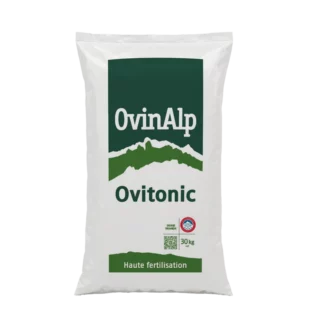
It is with this logic in mind that Ovitonic was designed. Formulated from rigorously selected sheep manure from the Alps (PGI Sisteron) and composted for twelve months according to an ISO 14001 certified process, it is enriched with fruit pulp, hydrolyzed animal proteins, potassium, and magnesium. This combination provides balanced nutrition while supporting the natural mineralization of organic matter and the formation of stable humus.
Thanks to cold pelleting without additives, Ovitonic preserves the integrity of its components and ensures a progressive release of nutrients into the soil. This controlled diffusion promotes regular assimilation by plants while sustainably stimulating microbial life. Applied in autumn or winter, it prepares the soil for spring vegetative recovery, supports the restart of crops, and contributes to consistent performance.
Its concentration allows for reduced doses compared to bulk organic fertilizers, simplifying spreading operations and limiting logistical constraints.
Ovitonic thus fits into a global approach to fertilization, where the soil and the plant are considered an inseparable whole, for more balanced, more resilient crops and quality production.